Gastrocnemius Rupture
Recover from calf muscle injury with personalised physiotherapy designed to restore strength, mobility, and confidence for walking, running, and everyday movement.
Contents
Take the First Step Towards Better Movement
Our experienced physiotherapists are here to help you improve mobility, regain strength, and move with greater comfort and confidence.
What is Gastrocnemius Rupture?
A Gastrocnemius Rupture is a partial or complete tear of the gastrocnemius muscle, one of the main muscles of the calf. It commonly occurs during sudden or forceful movements such as sprinting, jumping, pushing off, or quickly changing direction. The injury may cause sudden sharp pain in the calf, sometimes described as feeling like being kicked or struck in the back of the leg. Swelling, bruising, weakness, and difficulty walking or pushing off the foot may also occur. At Pure Physio, rehabilitation focuses on protecting the healing muscle, restoring mobility, gradually rebuilding calf strength and load tolerance, and helping you return safely to your normal activities and sports.
A Gastrocnemius Rupture is a tear involving the gastrocnemius muscle of the calf.
The gastrocnemius is one of the two main muscles that form the calf, along with the soleus muscle.
The gastrocnemius has two parts:
Medial Head: Located on the inner side of the calf.
Lateral Head: Located on the outer side of the calf.
It crosses both the:
Knee Joint
Ankle Joint
The gastrocnemius plays an important role in:
Walking
Running
Jumping
Pushing Off the Ground
Standing on the Toes
A rupture occurs when muscle fibres are stretched beyond their capacity and partially or completely tear.
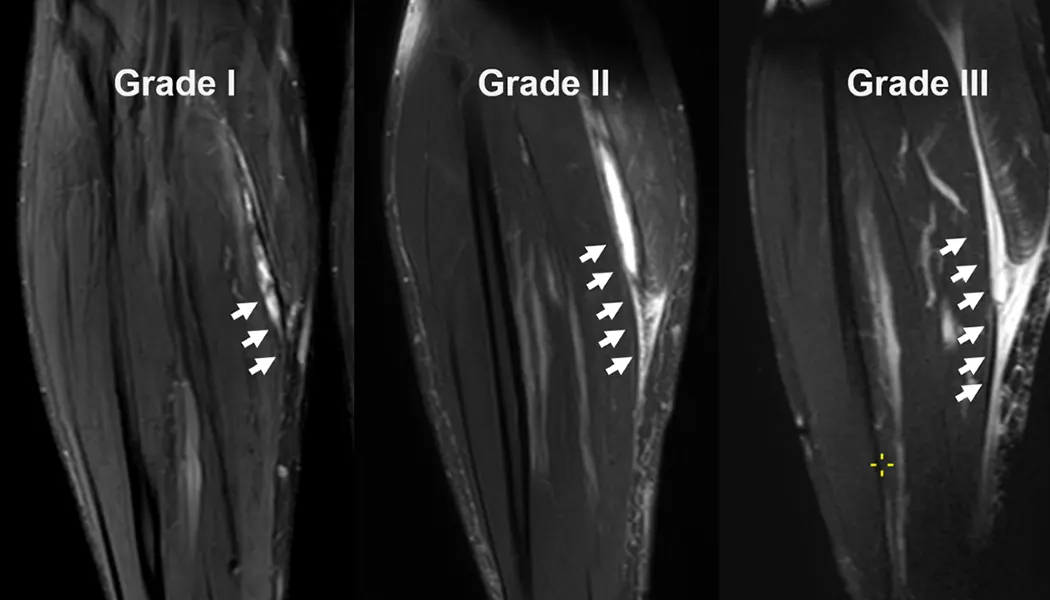
Gastrocnemius injuries are commonly classified by severity:
Grade 1 Strain
A small number of muscle fibres are damaged, causing mild pain and minimal loss of strength.
Grade 2 Partial Tear
A greater number of muscle fibres are torn, causing more significant pain, swelling, weakness, and functional limitation.
Grade 3 Complete Rupture
The muscle is completely torn, causing severe weakness and significant loss of function.
A sudden tear involving the inner part of the gastrocnemius near the muscle-tendon junction is sometimes referred to as “tennis leg.”
What Are The Symptoms Of Gastrocnemius Rupture?
Sudden Sharp Calf Pain: Pain often occurs suddenly during activity.
Feeling of Being Kicked: Some people describe the sensation as if someone has kicked or struck the back of the calf.
Popping Sensation: A pop or snapping sensation may be felt at the time of injury.
Calf Swelling: The injured area may become swollen.
Bruising: Bruising may develop in the calf or spread downward toward the ankle.
Tenderness: The injured muscle may be painful when touched.
Difficulty Walking: Pain and weakness can cause limping.
Difficulty Pushing Off: Pushing the foot against the ground during walking may be painful or weak.
Pain When Standing on the Toes: Rising onto the toes may be difficult.
Reduced Calf Strength: The injured leg may feel weaker than the unaffected side.
Muscle Tightness: The calf may feel tight or stiff.
Reduced Ankle Movement: Pain and swelling may limit ankle movement.
Visible or Palpable Defect: A significant tear may occasionally create a noticeable gap or defect in the muscle.
Difficulty Running or Jumping: High-impact activities may be difficult until recovery progresses.
Because calf pain and swelling can also occur with conditions such as an Achilles tendon rupture or deep vein thrombosis (DVT), appropriate medical assessment is important when the diagnosis is uncertain.
What Are The Causes Of Gastrocnemius Rupture?
A gastrocnemius rupture usually occurs when the muscle experiences a sudden force greater than it can tolerate.
Sudden Acceleration: Sprinting or rapidly increasing running speed can place high force on the calf.
Jumping: Powerful take-off or landing can overload the muscle.
Sudden Change of Direction: Quick cutting or turning movements may place the calf under excessive tension.
Forceful Push-Off: Strongly pushing off the ground during running or sport can contribute to injury.
Rapid Stretching of the Calf: The muscle may tear when the knee is extended while the ankle is suddenly forced upward.
Sports Activities: Tennis, football, basketball, badminton, running, athletics, and other explosive sports may increase the risk.
Inadequate Warm-Up: Starting intense activity without appropriate preparation may increase injury risk.
Muscle Fatigue: Fatigued muscles may have a reduced ability to tolerate sudden force.
Previous Calf Injury: A previous strain or incomplete rehabilitation may increase the risk of another injury.
Sudden Increase in Training Load: Rapid increases in exercise intensity, distance, frequency, or volume can overload the calf.
Reduced Flexibility: Limited flexibility may contribute to increased muscle strain during high-demand movements.
Muscle Imbalance: Reduced strength or poor coordination between lower-limb muscle groups may affect movement and load distribution.
Age-Related Changes: Changes in muscle and tendon tissue may influence injury risk.
Diagnosis Of Gastrocnemius Rupture
Medical History: A healthcare professional will ask how the injury occurred, whether a popping sensation was felt, and about pain, swelling, bruising, and difficulty walking.
Physical Examination: The calf is assessed for tenderness, swelling, bruising, muscle contour, and movement limitations.
Palpation: The healthcare professional may gently feel the calf to identify the location of tenderness or a possible muscle defect.
Range of Motion Assessment: Knee and ankle movement are evaluated.
Strength Testing: Calf strength and the ability to push off or rise onto the toes may be assessed when appropriate.
Walking Assessment: Gait may be observed to identify limping and other movement changes.
Thompson Test: A clinical test may be performed when an Achilles tendon rupture needs to be ruled out.
Ultrasound: Ultrasound can help assess the location and extent of a muscle tear.
MRI: MRI may provide detailed information about the severity of the injury and involvement of the muscle-tendon junction.
Assessment for Other Conditions: Further evaluation may be required if symptoms suggest an Achilles injury, blood clot, or another cause of calf pain and swelling.
Treatment Of Gastrocnemius Rupture
Treatment depends on the severity and location of the tear.
Protection: Activities that place excessive stress on the injured calf may need to be temporarily avoided.
Relative Rest: Reducing painful activity can help protect the injured muscle during the early stage of healing.
Compression: Compression may be recommended in appropriate cases to help manage swelling.
Elevation: Elevating the leg may help manage swelling when appropriate.
Pain Management: A doctor may recommend suitable medication when required.
Physiotherapy: A structured rehabilitation programme can help restore movement, strength, and function.
Gradual Mobility: Controlled movement is gradually introduced according to pain and tissue healing.
Progressive Strengthening: Calf exercises are progressed from gentle activation to higher-level strength training.
Balance and Proprioception Training: Exercises may help improve lower-limb control and confidence.
Gradual Loading: Walking, strengthening, running, and sports activities are gradually reintroduced.
Supportive Devices: Crutches or other support may be required temporarily in more severe injuries.
Surgical Treatment: Surgery is rarely required for most gastrocnemius tears but may be considered in selected severe or complex cases.
Return to sport should be based on recovery of strength, movement, function, and appropriate clinical assessment rather than time alone.
What Is The Physiotherapy Treatment Of Gastrocnemius Rupture
Detailed Assessment: At Pure Physio, rehabilitation begins by assessing pain, swelling, calf movement, ankle mobility, muscle strength, walking ability, activity demands, and recovery goals.
Early Protection and Load Management: We provide guidance on reducing excessive stress on the injured muscle while avoiding unnecessary prolonged inactivity.
Pain and Swelling Management: Appropriate strategies may be used to support comfort and manage swelling.
Gentle Range of Motion Exercises: Controlled ankle and knee movements may help maintain mobility as symptoms allow.
Gradual Muscle Activation: Early exercises may focus on gently activating the calf muscles without excessive strain.
Progressive Calf Strengthening: Exercises are gradually progressed to improve strength and load tolerance of the gastrocnemius and soleus.
Isometric Exercises: Static muscle contractions may be introduced during appropriate stages of rehabilitation.
Heel Raise Progression: Exercises may progress from supported heel raises to more demanding single-leg and loaded movements.
Eccentric Strengthening: Controlled lengthening exercises may be included when appropriate to improve calf strength and resilience.
Flexibility Training: Gentle stretching may be introduced at an appropriate stage to restore comfortable calf length and ankle mobility.
Balance and Proprioception Training: Exercises help improve lower-limb control and stability.
Gait Training: Therapy focuses on restoring a comfortable and efficient walking pattern.
Functional Training: Rehabilitation may include progressive exercises for stairs, fast walking, jogging, jumping, and direction changes.
Return-to-Running Programme: Runners may receive a gradual programme to rebuild running tolerance.
Sport-Specific Rehabilitation: Athletes can progress through drills based on the demands of their sport.
Home Exercise Programme: A personalised exercise plan supports recovery between physiotherapy sessions.
Why Choose Pure Physio?
Detailed Injury Assessment: We assess the severity of symptoms, movement limitations, calf strength, walking ability, and functional goals.
Personalised Rehabilitation Plans: Your programme is adapted according to the location and severity of the injury, stage of healing, activity level, and recovery goals.
Safe Loading Progression: Exercises are gradually progressed to help rebuild strength without overloading the healing muscle.
Focus on Calf Strength and Function: Rehabilitation targets the strength and endurance needed for walking, climbing stairs, running, jumping, and sport.
Movement and Gait Rehabilitation: We address walking patterns and lower-limb movement to support a confident return to activity.
Sport-Specific Recovery: Athletes receive progressive rehabilitation based on the running, jumping, sprinting, and change-of-direction demands of their sport.
Balance and Injury Prevention: Training may help improve lower-limb control and reduce factors that can contribute to future injuries.
Functional Return-to-Activity: Treatment is focused on helping you safely return to work, exercise, household activities, and other important tasks.
Individualised Home Exercise Programme: You receive appropriate exercises and guidance to support consistent progress outside the clinic.
Integrated Care Approach: If imaging or specialist assessment is required, physiotherapy can form part of a coordinated recovery plan focused on safe and effective rehabilitation.
Start Your Recovery Journey Today
Don’t let pain, stiffness, or reduced mobility affect your daily life. Get personalised physiotherapy care designed around your condition and recovery goals.