Dyslexia
Support better reading, learning, and everyday confidence with personalised guidance and therapy tailored to your child’s individual needs.
Contents
Take the First Step Towards Better Movement
Our experienced physiotherapists are here to help you improve mobility, regain strength, and move with greater comfort and confidence.
What is Dyslexia?
Dyslexia is a neurodevelopmental learning difference that primarily affects a person’s ability to read and work with written language.
People with dyslexia may have difficulty with:
Reading Accuracy: Recognising and reading words correctly.
Reading Fluency: Reading smoothly and at an appropriate speed.
Decoding: Connecting letters and groups of letters with their corresponding sounds.
Spelling: Remembering and accurately writing words.
Phonological Processing: Recognising and working with the sounds that make up spoken words.
Written Expression: Organising and expressing ideas in writing.
Dyslexia affects individuals differently. Some people experience mild difficulties, while others require more structured and ongoing educational support.
Dyslexia does not mean that a person is lazy, unintelligent, or incapable of learning. With appropriate assessment, evidence-based educational intervention, and supportive learning strategies, people with dyslexia can develop skills to manage reading and writing challenges effectively.
Dyslexia may be identified during childhood when reading and writing demands increase, although some individuals are not recognised until adolescence or adulthood.
What Are The Symptoms Of Dyslexia?
Symptoms can vary according to age and the individual. Common signs may include:
Difficulty Learning Letter Sounds: A child may take longer to connect letters with their corresponding sounds.
Slow Reading: Reading may be noticeably slower or more effortful than expected.
Difficulty Recognising Words: Familiar words may need to be sounded out repeatedly.
Reading Errors: Words may be skipped, substituted, misread, or read inaccurately.
Poor Reading Fluency: Reading may sound hesitant, choppy, or lack a natural flow.
Difficulty with Spelling: Spelling errors may occur frequently, including with common words.
Difficulty Rhyming: Recognising or producing rhyming words may be challenging.
Difficulty Breaking Words into Sounds: A person may struggle to identify and manipulate the individual sounds within words.
Confusion Between Similar Letters or Words: Some individuals may have difficulty distinguishing visually or phonetically similar letters and words.
Difficulty Remembering Sequences: Remembering the order of letters, days, months, numbers, or other sequences may be difficult for some people.
Avoidance of Reading or Writing: Reading and writing tasks may feel frustrating or exhausting, leading to reduced confidence or avoidance.
Difficulty Understanding Written Material: Reading comprehension may be affected when so much effort is required to decode individual words.
Slow Written Work: Writing assignments may take longer because of spelling, reading, and language-processing difficulties.
What Are The Causes Of Dyslexia?
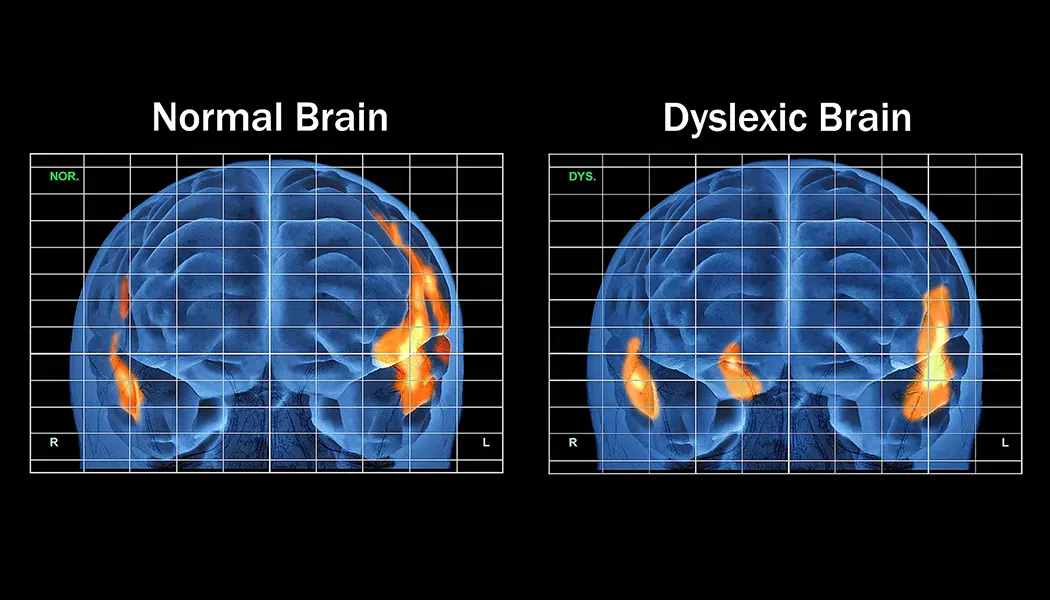
The exact cause of dyslexia is not linked to a single factor. It is generally understood as a neurodevelopmental condition influenced by differences in the way the brain processes language.
Genetic Factors: Dyslexia can run in families, suggesting that inherited factors may contribute to its development.
Differences in Language Processing: People with dyslexia may process speech sounds and written language differently.
Phonological Processing Difficulties: Difficulty recognising, remembering, and manipulating the sounds within spoken words is commonly associated with dyslexia.
Brain Development Differences: Differences in the development and functioning of brain networks involved in reading and language may contribute to dyslexia.
Family History: A child with a close family member who has dyslexia or significant reading difficulties may have a higher likelihood of experiencing similar challenges.
Dyslexia is not caused by poor parenting, lack of intelligence, laziness, poor eyesight, or a lack of effort.
Diagnosis Of Dyslexia
Developmental and Educational History: A qualified professional may ask about early language development, school performance, reading history, family history, and current learning difficulties.
Reading Assessment: Reading accuracy, speed, fluency, decoding, and comprehension may be evaluated.
Phonological Processing Assessment: A specialist may assess how well an individual can recognise and work with speech sounds.
Spelling and Writing Assessment: Written work may be evaluated to identify patterns of difficulty.
Cognitive and Learning Assessment: A qualified psychologist or other appropriately trained professional may assess cognitive abilities and learning skills when needed.
Language Assessment: A speech-language professional may assess spoken language skills and identify whether other language difficulties are contributing to reading challenges.
Vision and Hearing Assessment: Appropriate testing may be recommended when hearing or vision problems need to be ruled out.
Assessment for Other Learning or Developmental Difficulties: Some individuals may have additional conditions that affect attention, language, coordination, or learning and may require further assessment.
There is no single blood test, scan, or physical examination that diagnoses dyslexia. Diagnosis or formal identification is based on a comprehensive assessment by an appropriately qualified professional.
Treatment Of Dyslexia
There is no medical “cure” for dyslexia, but early, structured, and evidence-based educational support can help individuals develop stronger reading and writing skills.
Structured Literacy Intervention: Teaching approaches that explicitly and systematically develop reading, spelling, and language skills may be beneficial.
Phonics-Based Support: Structured teaching may help develop the connection between letters and speech sounds.
Phonological Awareness Training: Activities may help individuals recognise, separate, combine, and manipulate the sounds within words.
Reading Fluency Practice: Guided practice can help improve reading accuracy and speed over time.
Spelling Support: Structured techniques may help improve understanding and recall of spelling patterns.
Individualised Learning Strategies: Support is adapted according to the person’s age, learning profile, strengths, and areas of difficulty.
Classroom Accommodations: Depending on individual needs, support may include extra time, alternative ways of accessing information, assistive technology, or other educational accommodations.
Assistive Technology: Tools such as text-to-speech, audiobooks, speech-to-text, and spelling support may help individuals access learning materials more independently.
Psychological and Emotional Support: Support may be helpful when learning difficulties have affected confidence, motivation, or emotional well-being.
What Is The Physiotherapy Treatment Of Dyslexia
Dyslexia is primarily a learning and language-based condition, so physiotherapy is not a primary treatment for dyslexia. The main interventions should focus on specialised educational and language-based support.
At Pure Physio, physiotherapy may support associated physical or developmental needs when these are identified and clinically relevant. This could include:
Developmental Assessment: Where a child has additional motor or developmental concerns, physiotherapy may assess gross motor skills, posture, balance, coordination, and functional movement.
Balance and Coordination Training: Some children may have separate coordination or movement difficulties that can be addressed through an individualised rehabilitation programme.
Gross Motor Skill Development: Activities may support skills such as running, jumping, climbing, balance, and overall body coordination when these areas are independently affected.
Posture and Physical Comfort: Guidance may be provided where prolonged sitting or physical discomfort affects participation in school or daily activities.
Functional Physical Activity: Appropriate movement and physical activity can support general health, fitness, participation, and confidence.
Multidisciplinary Referral: When dyslexia is suspected, we can recommend assessment and support from appropriately qualified educational specialists, psychologists, or speech-language professionals.
Physiotherapy does not replace specialised dyslexia assessment or structured literacy intervention.
Why Choose Pure Physio?
Individualised Assessment: We consider each child’s or individual’s physical, developmental, and functional needs.
Child-Centred Approach: Support is tailored to the person’s abilities, challenges, comfort, and individual goals.
Focus on Functional Development: Where physiotherapy is clinically appropriate, treatment may focus on movement, coordination, balance, physical confidence, and participation in everyday activities.
Support for Associated Physical Needs: We can address relevant motor, posture, balance, or functional movement concerns when they are present alongside learning difficulties.
Family Education and Guidance: Parents and caregivers may receive practical guidance to support appropriate physical development and participation at home.
Multidisciplinary Care: We recognise that dyslexia requires specialised learning support. Where appropriate, we encourage coordinated care with qualified educational, psychology, speech-language, and other relevant professionals.
Focus on Confidence and Participation: Our goal is to support the individual’s overall physical function and confidence while helping families access the right professional support for learning and language needs.
Start Your Recovery Journey Today
Don’t let pain, stiffness, or reduced mobility affect your daily life. Get personalised physiotherapy care designed around your condition and recovery goals.